Wednesday, December 26, 2012

Feeder report


A 20 minute feeder watch on Dec 22, here in Newton Center, yielded 15 species:

Mourning Dove  5
Red-bellied Woodpecker  1     m
Downy Woodpecker  2
Blue Jay  2
Black-capped Chickadee  2
Tufted Titmouse  4
Red-breasted Nuthatch  2
White-breasted Nuthatch  3
Carolina Wren  1
White-throated Sparrow  1
Dark-eyed Junco (Slate-colored)  4
Northern Cardinal  1     m
House Finch  1
American Goldfinch  4
House Sparrow  9

This brings together the crew that's been around for about a month. 


Sunday, December 16, 2012

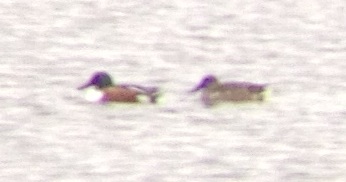
Flight of the Northern Shovelers

Northern Shovelers
 I really wanted to join the Christmas Bird Count this year (see Suzette's post), but unfortunately knew that I wasn't going to be able to. So I started this weekend thinking there wasn't going to be any birding. But after dropping a sick pet off at the vet early this morning I couldn't resist taking a lap around Chestnut Hill Reservoir to clear my mind.

Upon arriving I quickly noted many gulls, Canada geese, ruddy ducks, common mergansers and hooded mergansers. But before I had even started walking around the pond, a pair of ducks caught my eye, as no one other than the northern shoveler has the green head, white breast, and chestnut sides! I haven't seen any this close to Newton so I was very excited. I made my way around the reservoir also noting mourning doves, golden-crowned kinglets, a downy, a titmouse, a hermit thrush, and even a brown creeper. The creeper has eluded me since moving here, so apparently I had to stop looking for them to find one. I have frequently heard them calling, but this was the first time in years I had gotten to see one!

I worked my way to the shore nearest the shovelers to get good views of them and was able to just make out the large trademark bill. I also tried to take a picture with my phone through my binoculars. At least I think its good enough to identify them! As I carried on around the water, I added goldfinch, white- and red-breasted nuthatches, a lone pied-billed grebe, and a handful of house sparrows to my list before heading out.

I quickly learned that this is the first ebird report of nothern shovelers at Chestnut Hill Reservoir and then a few hours later saw the first ebird report of shovelers at Hammond Pond. I then checked a little more carefully and saw that the shovelers were no longer being seen at the reservoir and so it seems likely that the same pair probably moved over to Hammond Pond! Maybe they were visiting the redheads. I'll be curious to see how long the northern shovelers might stay with us.

Saturday, December 15, 2012

Redhead Ducks at Hammond Pond

Redhead Ducks
 While I had already posted about the redhead ducks at Hammond Pond, I wanted to try and find them as well. For my first attempt several weeks ago, I arrived too late at the pond and the light was starting to fail, so even if they were there I wouldn't have been able to see them at the far side of the pond. But my second trip was a success!

At the overlook by the Container Store, I could initially only make out our resident common and hooded mergansers diving at the far end of the pond. The flashing white of the male mergansers probably helped to draw my eye. Soon after, I was able to see between the mergansers and finally spotted four redheads (2 males and 2 females) in the far corner.

Hooded Mergansers
At this point in time, several other birders showed up to view these uncommon ducks and fortunately they had a scope and were kind enough to allow me views of the action. I have always been concerned that it would be difficult to tell canvasbacks and redheads apart, but these weren't that challenging to identify. The back is grayer and the head more rounded than a canvasback. However, the best give away for me was the blue-gray bill and black tip while the canvasback has an all black bill. Redheads primarily breed in the Western US, including the prairie pothole region of the upper Midwest and Canada and while some birds winter along the Eastern seaboard, they tend not travel as far up the coast as Massachusetts. So we are quite lucky that these individuals decided to stop at Hammond Pond. Others have reported up to five redheads, so does that mean that the third female was hiding in the back corner of the pond or did she find another local pond to visit?

As we were watching the redheads, they started to slowly work their way to the west, all the while diving to feed. At this point I headed over to the overview at the DCR parking lot and found a few mallards and ring-billed gulls while a flock of Canada geese passed overhead. From this vantage point, I was able to stand hidden behind a tree to get great views (and pictures) of the redheads and hooded mergansers. Between the redheads and the Eurasian teal, we sure are lucky with our visiting waterfowl.


Redheads

Monday, December 10, 2012

Recurring Eurasian Green-winged Teals at Newton City Hall

Green-winged Teal (American)
 Yesterday I headed over to Newton City Hall for a little birding of its small habitat. At just under 4 acres, the stream and trees make up probably the most productive small habitat for birding in Newton. In the summer the little mudflats are a really good bet for solitary sandpipers and slightly less frequently spotted sandpipers. In the winter the mudflats are flooded and are popular with waterfowl that love shallow muddy habitats, like hooded mergansers.

This visit though was inspired by ebird reports of an Eurasian green-winged teal and a few of its American cousins. While the Eurasian and the American green-winged teals were once two separate species, they are currently considered subtypes. Even still, the allure of seeing the rare Eurasian counterpart drew me to city hall.

Green-winged Teal (Eurasian)
The first finds were song and white-throated sparrows, then as I crossed one of the little footbridges, I saw a mallard pair that dwarfed a nearby group of teals. This was a strong reminder that the green-winged teal is our smallest dabbling duck. I quickly searched the 8 ducks looking for the vertical or horizontal white stripes that are the best discerning feature for the American and Eurasian subtypes. I was a little disappointed to see that all of the males had the vertical line of the American type. But I was quickly seeing the silver lining with the closest views I've had to date with green-winged teals. The males (and the females) were even showing off for me by flashing their namesake iridescent green wing patches as they swam, fed, and preened.

Red-breasted Nuthatch
Soon I decided I needed to keep searching the area for other residents.  A red-breasted nuthatch was working a tree right by the path, but was so fast I could hardly keep the manual focus of the camera on her. I kept working my way around the ponds keeping an eye out for the Eurasian. In the mean time I found a flock of turkeys, cardinals, house sparrows, house finches, chickadees, a white-breasted nuthatch, a mockingbird, and a red-tail floating lazily overhead.

By the time I made a complete circuit of the area, I saw a lone teal. And this one did not have the vertical white stripe! Finally the Eurasian teal revealed. He must have been hiding my first time around. I snapped some pictures before I realized that this teal did not have a horizontal stripe either. I kept following watching him only to later see that the feathers that make up the white stripe were just hiding, but they were there (second photo). Interestingly, the entire time I watched him, he never associated with the American type teals.

Green-winged Teal (Eurasian)
After getting home I was reading about distinguishing between the American and Eurasian (also known as the common teal in Europe) types from a great article from David Sibley. This Eurasian demonstrated some of these features, having bolder white lines on the face and a grayer less buffy breast. But what really has me stumped is the ebird sightings. Most Eurasian green-winged teals are rare and do not reoccur. Not this bird, or this spot. Between Newton City Hall, Newton Cemetery, and Cold Spring Park, a Eurasian green-winged teal has been seen regularly. Sightings were from Spring 2009 at Cold Spring Park, Winter 2010 at Newton City Hall (There was a blog post from Scott at this time), and now again this Fall 2012 at Newton City Hall. This seems totally strange that Newton should be ground zero for Eurasian green-winged teals. Is this the same bird that is now living here in the US and regularly returns to a favorite spot? Or are we seeing multiple individuals that have all independently decided to grace us with their presence? Most ebird sightings that I see have Eurasian teals that were seen for a month or two in a given spot. And that is it. To have such regular sightings seems the exception, where we are seeing (the?) Eurasian teals for 1-2 months over 3 of the last 4 years. Will he return next year?
Northern Mockingbird

I have no idea, but this is certainly going to make our winters more interesting and make Newton City Hall a definite spot to check out more regularly. Who knows how long this might continue!


Sunday, December 2, 2012

Another Barred Owl

After the last post about the Millinium Park Barred Owl and the Hammond Pond Redheads, I kept thinking about all of the barred owl sightings that have been reported on massbird. With all the barred owls showing up all over Boston, I was thinking that I should remind everyone to keep their eyes and ears out for barred owls as there is a good chance we might find some in Newton.

Typically our most common owls are the eastern screech and great horned owls, while barred owls tend to like larger forested spaces and so are less common in urban or suburban environments. (There are a total of 11 owl species that can be found in MA, with 7 species that breed in the state). in fact, the recent barred owl at Millenium is the first record for that park, even though many great birders frequent that spot. Barred owls still show up regularly in Newton with sightings at Nahanton park (check out Suzette's picture) and I might have caught a brief glimpse of the Cold Spring Park owl that was seen this spring.

This morning was a different story though. I did not get enough sleep last night and one of my pre-sunrise walks around the house resulted in my hearing the strangest sound through a window. I only needed to hear the one utterance to nail down the "who cooks for you, who cooks for you all" distinctive song of the barred owl. This was an exciting find, especially as an accidental yard bird. When I am able to muster up the energy I may head out to see if it isn't roosting nearby. This also now makes 4 owl species for me this year including great horned, eastern screech, snowy, and now the barred. And only the snowy owl from Duxbury was from outside Newton. I still have a ways to go if I want to find all the MA owls, and I hear that the long eared owl is notorious difficult to find. But its been a pretty good year considering I started it at Nahanton Park looking for owls.


P.S. As I was writing this post, a Cooper's hawk crash landed with a somersault over some bushes in the yard. I know birds are amazing fliers, but my amazement at their abilities is at its absolute peak when watching an accipiter in break-neck pursuit of some poor bird.  Her prey escaped and they both headed off down the street before I could even grab binoculars.

Friday, November 30, 2012

Breaking News: Barred Owl and Redheads

I was just reading Massbird and several sightings caught my eye that I wanted to share. A barred owl has been seen at Millenium Park over the last few days (I believe it was originally found my Marry Lou) and is reliably located near the foot bridge over the Saw Mill Brook. Click here for a picture. Then at Hammond Pond several individuals have seen redheads (pictures here) Quite exciting finds around Newton.

I would really like to go find both of these, as I have never actually seen a barred owl (I've only heard them) and this would also be my first for MA. And the readheads would be a lifer for me. Maybe I'll have to see if a can't spare a few minutes this weekend to track down one or the other.

This just serves to remind me of all the great birders around Newton and I would like to make it easier for more people to contribute. So I'm creating a new email address that you can use if you want to share your own sightings.  Please use: wildnewtonblog(at)gmail(dot)com

Dec. 15, 2012 Update. I recently got over to Hammond Pond and was able to see and photograph the redheads in this post.

Saturday, November 17, 2012

Mergansers Retern to Hammond Pond

Hooded Mergansers
  I birded around Hammond Pond today a little bit after noon. Definitely not prime birding time, but I was mostly interested in the waterfowl especially as the weather has been getting chillier. I was not disappointed. The hooded mergansers are back and I had fun watching them dive for fish between the mudflats. I think that these have to be one of the most visually striking birds in the states. Another surprise was a young double-crested cormorant sleeping on a mud flat. Also present were a single Canada goose and several mallard pairs. In the back corner I thought I could just make out a common merganser too. More to the woods there were blue jays, chickadees, titmice, juncos, robins and a white-breasted nuthatch. I also got a great close-up view of a gorgeous male downy and his red patch. I also thought I might have heard the three noted "tsee-tsee-tsee" of a golden-crowned kinglet. I am certainly going to enjoy seeing what this winter might bring to our ponds and lakes!