Friday, June 22, 2012

Savannah Sparrows of Millennium Park

Savannah Sparrow
   A few days ago I got in an early morning at Millennium Park and beat our recent heat wave. The first thing I heard were red-wing blackbirds, robins, song sparrows, and savannah sparrows. The introductory notes and two buzzy phrases of their songs compelled me to start up the hillside in search of these grass loving sparrows. While the first group of birds I came across were house sparrows, I quickly found plenty of savannahs, with the males all jockeying for good perches from which to sing. I was actually slightly surprised by the amount of savannah song, I would have thought they would be in chick raising mode, not defending territory and finding mates. During the summer months they primarily eat insects (including spittle bugs), while in the winter they switch to seeds. One male hopped up on a sign post right in front of me (it was the tallest perch around) and started to sing. This allowed me to grab a good recording of a song that is often too faint. I also had some great views of his yellow eyebrow that is his most striking feature. The savannah sparrows song is roughly similar to our more common song sparrows. Both have several introductory notes and end in trills. But while the song sparrow has a highly variable middle portion, the savannah has another trill that is a higher pitch than the trill he ends with.


Red-winged Blackbird
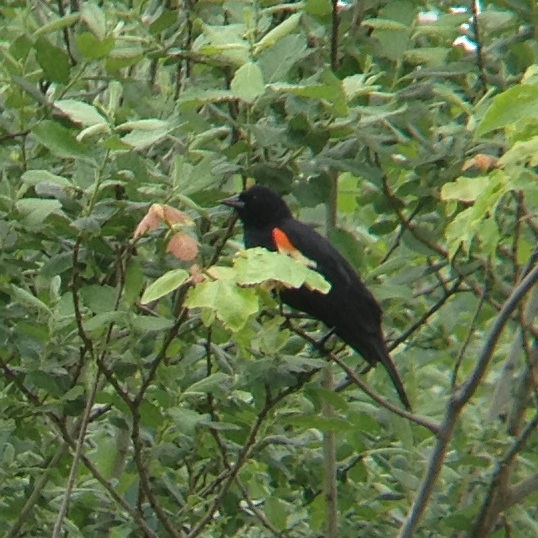
After spending some time amongst the savannah sparrows, I headed back down the hill towards the boat ramp. In the marshy area right by the parking lot red-winged blackbirds were calling and even found a female or juvenile with a good amount of orange on the head the throat. When the water is low, mudflats along the Charles are revealed and provide shorebird habitat. But today, with higher water, only two mallards were working the weeds. Warbling vireos, Baltimore orioles, downys, cardinals and a female red-breasted grosbeak were all found along the path near the river.

Female Yellow Warbler with Caterpiller
Yellow warblers seemed to be everywhere I turned, with males singing brightly and numerous females foraging as well. Tree swallows were likewise ubiquitous, sweeping low over the river or above the grassy hillsides. I kept checking the brook hoping for herons or rails (I once found a sora here). Just as I was thinking it was odd that I hadn't seen a single heron, two great blues flew over head, one after the other.


Cedar Waxwing
On the side of the park opposite the river, I encountered a gregarious flock of cedar waxwings with one individual who almost seemed to pose for me. She was lacking the waxy red tips of her wing feathers which are so endearing to this species. Does this mean she was a younger bird? But the silken smoothness of the rest of her feathers was quite evident. All the while watching the waxwings, a common yellowthroat's song came floating up from the marsh. Even though I spent a fair amount of time looking, yellow warblers were the closest thing I found.

Beyond the birds, there was a small mouse or vole that ran across the trail, but it was so fast I didn't get a chance to check it out. I was able to get three good pictures of the wildflowers being grown on the hillsides that make Millennium Park such a great habitat. I didn't have enough space to share them here, so I'll post a new flower picture every few days so you can see them.

Saturday, June 16, 2012

Turtles

Female Snapping Turtle
While I started this blog primarily thinking about the avian life around Newton, this snapping turtle compelled me to expand my subject matter.

I was recently walking near a shallow muddy pool and was completely taken aback by seeing this large dug up patch of earth whose center resolved to be this female snapping turtle. I am calling her a female because it appears as though she was digging a nest to lay her eggs. She seemed so out of place, the most dinosaur like turtle I have ever seen. While this particular turtle was not in Newton, I learned that June and July is peak egg laying season for them and they prefer shallow ponds, lakes, and streams, of which Newton has plenty of. So it seemed likely that others might encounter them in Newton. Snapping turtles also have long flexible necks that do not fully retract into their shells, so they have developed a snapping bite for defense. One word of caution is that while they tend to shy from humans, their bite can be quite enough to liberate fingers from hands, so please give them a wide berth.

Painted Turtle
Thinking about this snapping turtle reminded me that last year I also found a painted turtle on the sidewalk a block or so away from Houghton Gardens! So I decided I'd include a picture of our own Newton turtle as well. The painted turtle is one of the most common turtles in our area and easily found sunning themselves on logs.  This one was walking down the sidewalk (Where was he going?) and withdrew into his shell when I approached.

While reading up on these turtles, I remembered another Newton blog, Natural Newton, where the author knows much more about the diversity of our flora and fauna than I do. So check out an article about the turtles of Newton if you are interested in knowing what types of turtles you might find here. Also there is a nice article with pictures of snapping and painted turtles found in Nahanton park.

Sunday, June 10, 2012

American Robin: A Close Encounter

The nice weather recently has led me to open windows at night, which means that the dawn chorus  will occasionally wake me up earlier than I would rather. One morning I snapped awake, instead of the slow return to awareness that the bird song usually brings. The song of what I thought could have been a scarlet tanager (similar to a robin but more burry) cut through my brain bringing me to full alertness. By the time I got dressed and headed outside I no longer heard anything like a tanager, but I decided to grab my binoculars and camera and sit on the back steps.

Brown-headed Cowbird
I heard lots of robins, chickadees, crows, and grackles while sitting in the calm before the human residents were yet awake. A brown-headed cow bird perched at the top of the a nearby cedar tree singing his high-pitched song. After only a couple of minutes a pair of great blue herons flew low over head, which was quite a surprise to me! Soon there after, an American robin caught my attention at the far end of the yard. This was a female robin as her head was gray (not black) and her breast was not the deep burnt orange of a male, but more interestingly she had a worm in her mouth. Now I think the following encounter can be told in pictures alone.


After watching the female robin make several trip to this bush and getting lots of pictures I decided it was time for breakfast. All the while eating, I kept thinking about what was in the bushes that was so interesting to her. I was hoping there might be a robin nest (though the in retrospect I realize that robins like to have their nests a little higher), so I swapped the telephoto lens for the normal kit lens on the camera and head back outside to see what I could find.

Juvenile Robin
I was quite lucky that this young robin was so photogenic and didn't mind my presence. Typically I would largely ignore robins when birding our local parks, but sitting in my own back yard they became great subjects of study. I think robins, with a funny turn of fate, seem much more benign than the otherwise might. American Robins are named by our early European settlers after the European robin, which shares an orange breast, though they are not related. Our American robin is actually a thrush (notice the speckled breast of the juvenile in the picture above) related to the wood thrush, hermit thrush, veery, and bluebird. I've even seen some refer to them as black-headed thrushes, which sounds quite a bit more exciting that the robin of grassy lawns that we think of today. In the spring and summer robins forage grassy areas for worms and insects, which makes them sensitive to pesticide use on lawns. While in the fall and winter robins are voracious fruit eaters, greatly enjoying small berries. Even though robins are frequently overlooked, their song is one of the most recognized (and enjoyed) by birders and non-birders alike.

Saturday, June 2, 2012

Re-visiting Newton Cemetery

All of the pictures that I have taken for Wild Newton and Nahanton Park blogs have all been using my camera phone held up to my binoculars. While I have quite enjoyed taking pictures like this, I was starting to feel its limitations and recently got a Nikon DSLR and wanted to take it for a spin. I fortunately have an older 70-200mm telephoto lens from my 35mm SLR which I was able to use with the new camera,  so I headed out to Newton Cemetery hoping to try out this new method of photographing birds.

Red-winged Blackbird
Cedar Waxwing
Mostly we had the same birds as last time with lots of blackbirds, Baltimore Orioles, and kingbirds. While the kingfisher was absent I was able to pick up a female brown-headed blackbird. By the back pond there was a flock of cedar waxwings calling with their soft high pitched songs that I could hardly hear. But as soon as I saw one, I noticed the rest of the flock. I even caught a bird I didn't recognize at first, whose breast was a deeper color than a robin's and had a black back. It took me a minute to realize that this was an orchard oriole!

White-breasted Nuthatch
While I was watching the orioles and waxwings I noticed a white-breasted nuthatch on the trunk of a huge old oak. Though I'm not quite sure why, but he drew in my attention and I watched him traveling around the trunk. This bird was definitely the male as the cap on his head was such a solid dark black (females have a lighter cap).


Then suddenly a second nuthatch appeared in what I had previously assumed was a knot in the tree and launched herself into the air. I was lucky enough to catch the changing of the guard!


As she soared away, the male entered the cavity only to re-appear after a few moment before he too flew off.

They were probably both off for their evening dinner before settling down with their eggs or young. I was quite amazed at my fortune for stumbling upon this nuthatch cavity nest. These white-breasted nuthatches are a common backyard bird in Newton and love to visit feeders in the winter, they prefer insects when they are available.

While I'm sure the new camera was much faster than my phone, many of the pictures were blurry, I almost think I might have done better with my phone and binoculars. Because this is an old lens, it doesn't auto-focus meaning I'm trusting my eye to focus on a small bird in a small view finder.  It also isn't a very high quality lens, but I think there may be more tricks to help coax crisper shots out of it. All in all it was a great evening walk in Newton Cemetery.


Saturday, May 26, 2012

An Early Summer Afternon at Hammond Pond


A hungry mallard
At about 2pm today I stopped by Hammond Pond briefly to see if there might be any spotted sandpipers feeding on the lily pads.  From the over looks at the parking lots I could not spot any sandpipers, but I was quickly greeted by the songs of a Baltimore oriole and warbling vireo while an eastern kingbird splashed down into the water right in front of me before flying off.

Visiting Hammond Pond is a mixed experience for me these days. There is a lot of construction at the shopping center, but the trees blocked most the activity from view. However, on the pond itself, there is a floating "raft" holding up a pipe that looks like it is being used to pump water out of the construction site. I don't know about you, but I cannot imagine that this particular activity is any good for the health of the pond. The company that owns Chestnut Hill Shopping Center, WS Development,  is responsible for about 25% of the land abutting Hammond Pond. The proximity of the parking lots to the water edge increases run-off and pollution and would not be up to current development standards. I am worried that they are not as concerned about the health of the pond or the residents who enjoy it as they should be. They must appreciate the pond's beauty, however, as they are also about to replace the building that currently holds City Sports with a taller building with the top floor (with an excellent view of the pond) serving as their corporate headquarters.

Red-winged Blackbird
But I pushed these thoughts from my mind and concentrated on the omnipresent blackbirds and their raucous calls. A few Canada geese floated out on the pond, and a single mallard flew over and pretended to preen; I think she really just was looking to see if I might offer her something to eat. A great blue heron flew across the pond, while a second stalked the shallows on the far shore. My last find of the day was a red-tailed hawk lazily soaring over Hammond Pond.

According to eBird data, Hammond pond and the surrounding woods (including Webster Conservation Area and Houghton Gardens) is one of the best birding locations in Newton, second only to Nahanton Park. I just hope that we can keep it that way.


Hammond Pond


Tuesday, May 22, 2012

A Birdy Spring Afternoon at Newton Cemetery

Newton Cemetery
Earlier this month there was a mass bird post from some Newton birders noting the warblers they found at Newton Cemetery. That reminded me that Suzette and Scott would posts from the Cemetery, noting rarities like a Eurasian Widgeon. Between that and wanting to stay out of really woodsy areas for tick purposes, Newton Cemetery seemed like a great destination on Sunday. Similar to its more famous cousin, Mt. Auburn Cemetery, Newton Cemetery is a garden cemetery and its beauty struck me as soon as I entered the grounds just after 5pm. The azaleas and rhododendrons were in full bloom and the massive oaks lining the shores of the ponds added to the serenity.

Red-tailed Hawk in a Rhododendron
Blue jays and warbling vireos assaulted my ears as I walked the roads and paths following the ponds and streams across the grounds. Baltimore orioles added their wonderful songs to the air. I ran across a large group of agitated grackles who alerted me to the presence of a red-tailed hawk they were mobbing. The hawk seemed almost oblivious to me, being more concerned with keeping her head down or wanting me to flush a rabbit, squirrel, or muskrat on my walk. (Cornell Lab of Ornithology has an awesome streaming camera on a red-tailed hawk nest full of young hawks).

Warbling Vireo
At the next pond a dry rattle announced the presence of a belted kingfisher who shyly headed off before I could see more than some blue wings. Though a pair of eastern kingbirds didn't seem to mind as they called constantly making a few splash-downs on the surface of the pond. Were they hunting or drinking? If the later it was so much less elegant than a swallow's graceful in-flight drink. The path along the little steam yielded a warbling vireo, while he didn't want to sit still he seemed to enjoy the attention I was giving him from just a few yards away as he flitted between branches and occasionally dove at the stream making and auditory splash before returning to the brush. Was he drinking? After about 20 blurry pictures I finally got a good pose. This close encounter with the warbling vireo was certainly the highlight of the walk.

A Juvenile Robin
The only warblers were some Yellows, but the abundance of brightly colored orioles made up for the low warbler count. On my way back, I again passed the mob of grackles and the red-tail, I was starting to feel sorry for her, but the harassing must have been worth it or she would have moved further away. Just then I saw a flash of dark blue across the lake and was able to finally have a distant but good view of the belted kingfisher with her double breast bands of navy and burnt orange. A great way to end my walk at the Newton Cemetery.

Sunday, May 13, 2012

May Migrants at the Emerald Necklace: Riverway

A Goldfinch Pair
Boston's Emerald Necklace is just a short T ride down the D-line. While most Boston area birders prefer the Back Bay Fens or Arnold Arboretum, the Riverway is right off the D-line and quite convenient to Newton birders. This narrow strip of park is centered upon the Muddy River and connects the Fens to Olmsted Park and Jamaica Pond, and fortunately offers enough habitat to offer shelter to tired migrants. I recently decided to stop off for some birding at Riverway on my way into Boston.

After getting off the T, the Riverway is accessed directly from the Longwood stop by heading over what I can only assume is a dike to ensure that the Muddy River and the T tracks never meet. As Riverway has paved or gravel trails on both sides of the River I decided to make a loop with Park Dr. on one side and Brookline Ave. on the other.

Black-and-white Warbler
Right away my ears were asaulted by the songs of Nothern Parulas, Black-throated green and Black-and-white warblers. The songs even led my eyes to these warblers for some great views (the Parula was quite high in the oaks).  Ovenbirds called from the under growth, but never showed. While walking the banks of the Muddy River I noted that there were a couple of families in the river, both Mallard and Canada Geese. The goslings were starting to get lanky and less cute, but the mallard chicks looked more like corks bobbing in the water than the smooth paddling of their mom.

Northern Waterthrush
Further down the trail, the river widens forming large pools with small islands. These islands were quite popular with warblers where I heared a Black-throated Blue's buzzy "zoo zoo zoo zree" song! An American Redstart showed up flashing his brilliant red-orange patches on this black body and calling "tse tse tse tse-o." Along the shores of the river I found a small thrush-like bird bobbing his tail, a Northern Waterthrush, a warbler that looks and acts like thrushes by foraging on the banks of streams and ponds and sharing a spotted breast with thrushes. And speaking of thrushes, was even lucky enough to catch the song of a Swainson's thrush. A beautiful flute-like raising song that he sang softly until a dog got a little too close for comfort and he became nervous. The spotted thrushes (including Veery, Wood, Hermit, Swainson's thrushes) are among North America's best songsters and as I have only heard the Wood Thrush's ethereal song before, I was disappointed not to be able to snatch a recording of the Swainson's Thrush song. I was able to spot him well enough to make out the buff colored spectacles and face that is the hallmark of the Swainson's thrush.

Just before leaving I managed to find a Common Yellowthroat, a Spotted Sandpiper, and a female Red-wing Blackbird on her nest (she flew off just before I could take a picture).


The Longwood Ave. bridge over the Riverway was originally designed by Frederick Olmsted, the master planner for the Emerald Necklace.