Showing posts with label Hammond Pond. Show all posts

Friday, August 1, 2014

Osprey Over Hammond Pond

Hammond Pond

Eastern Kingbird
 Last weekend while running errands in Chestnut Hill, I decided to check out Hammond Pond (without my main camera) and see if there were any shorebirds around the pond. I was not disappointed as I quickly found some very vocal and active Spotted Sandpipers chasing each other around. They were the only shorebirds, but it is probably early yet for the handful of others that frequent the pond. Additional highlights included a number of Green Herons that could be seen in the shallows around the pond. Up in the trees an Eastern Kingbird was so busy bringing a fledgling food, that they didn't mind me and I received some great views. And as I was leaving an Osprey made an appearance over the pond. This was only my 2nd sighting of an Osprey at Hammond Pond and 4th record in eBird, so it is always nice to see one. I actually just realized while putting this post together that the Osprey is visible as a small dark speck in the picture of the pond.


Tuesday, May 20, 2014

Houghton Gardens: The Warbler Rest Stop

Female Northern Parula
Sorry for this late post, things have been busy.

At the end of last week, I stopped by Houghton Gardens and Hammond Pond. I have always though that Houghton Gardens would be a great place for warblers, so when I read a report from Marygrace that included a Prairie Warbler, I figure this was be a great time to see Houghton Garden’s Potential.

It really was a good day for warblers. Singing Blackpolls, Black-throated Greens, and Black-throated Blues, and Black-and-whites greeted me. A Northern Parula was spotted working a spider web. I couldn't decide if she was looking for bugs caught in the web,
American Bullfrog
or if she was gathering it for nesting material, though the later seems unlikely. If you look closely in the picture you should be able to see the spider webs. High in the canopy I eventually tracked down two songsters to reveal Magnolia and Chestnut-sided Warblers. I thought I might hear a Blackburnian song, but had trouble tracking it down. If an American Redstart wasn't nearby, I would have been more confident of a heard only identification. Though while searching for the singer I startled an Ovenbird. Through in a Pine Warbler, a Yellow-rumped Warbler, and a Yellow Warbler and you get quite  a good density of warblers in the tiny Houghton Gardens.

Common Yellowthroat
The diversity of plants and dense brush must make Houghton an ideal road-side rest stop on their northward migration. Just across the tracks into Webster Woods behind Hammond Pond and the spacing between trees is great, the understory is more open, and a veritable desert to the warblers. They all seem to have decided that Houghton Gardens was the place to be. Though I was able to add Cedar Waxwing, Common Yellowthroat, and a Wilson's Warbler to the morning, just so that Hammond Pond could redeem itself.
 

Monday, April 21, 2014

Early Migrants Around Newton

Green Heron
 On my way to work yesterday I stopped off at Hammond Pond (checklist), Houghton GardensLost Pond / Kennard Park, and finally Newton City Hall.  When I pulled into a parking spot at the overlook for Hammond Pond, a bird flushed from the grass by the inlet and I was surprised to see a Green Heron. (I later learned this is only the 2nd eBird record for Green Herons in MA this spring!) Usually I think of Green Herons as skittish and shy, but this bird only flew a few feet before landing. I hadn't even gotten out of the car yet and I was busy watching him with my binoculars. When he disappeared from view behind a bush. I slowly opened the door, and using the car for cover, crept around the side. There was no sign of a green heron, so I stopped being careful and approached the water's edge looking at for waterfowl. Just when I had forgotten about the heron, he leapt up from right in front of me, a testament to their camouflage, and landed in the adjacent bush. I immediately crouched and froze, starting a staring contest at a distance of 4 meters.

He eventually decided I wasn't interesting and began to use slow and calculating movement to make his way to the outer branches that overhung the water. I'd seen this look before, this was a master hunter on the prowl, creeping up on his prey. Eventually he was poised right above the water and leaning so far forward that I thought he must fall over.

Green Heron with Fish
At about this time, the Red-winged Blackbirds had taken notice of me and were scolding while Wood Ducks and Common Mergansers swam past. Then the familiar rattle of a Belted Kingfisher greeted my ears. I glanced up to observe the kingfisher flying towards me, catching sight of me, then turning back around to find another hunting perch, all the while giving her rattling cry.

Splash! I whipped my head around and the Green Heron was in the water. He had fallen in, as I feared he must, but wait - there was small fish clamped tightly in his bill! He made an awkward leap and returned to the branches, crest raised, to enjoy his meal. Now if only that darn kingfisher hadn't chosen that moment to fly by, I'd have seen the strike. But its hard not to look at a kingfisher. At this point the heron looked up and seemed to notice me as if for the first time and for posterity's sake, decided it was time to wander off into the grass surrounding the pond.

Ruby-crowned Kinglet
What a site to witness. But it was time to see what the rest of the pond had to offer. When I entered the woods, exuberant Ruby-crowned Kinglet song greeted me. Further along the trail I was pleased to find an Eastern Phoebe and my first warbler of the year with a bright yellow Palm Warbler. The high wheezy call notes of a Blue-gray Gnatcatcher guided my eyes to find several of these mini-mockers scattered through the woods. At the back of the woods I was lucky to see a Hairy Woodpecker chasing a Downy Woodpecker, it was great to compare them side-by-side and see how different their bill shapes are.

Back in Houghton Gardens (checklist), I found more of the usual, including another Blue-gray Gnatcatcher. I was hoping that a Pine Warbler might be gracing the gardens, but I did not hear any. I did manage to finally see a Ruby-crowned Kinglet though.

Next I headed over to Lost Pond and Kennard Park (checklist) hoping that the larger area of evergreens might hold a Pine Warbler. I really enjoy the Lost Pond area, though it isn't quite as bird-y as other Newton birding locations. This morning the pond held a few Mallards and a female Wood Duck. And while looking for ducks, this Ruby-crowned Kinglet started to sing near by and came even closer so that we had great views of each other (I was really excited to see that this picture turned out so well).

Pine Warbler
Further down the path there was another Gnatcatcher but once I got into the pines of Kennard Park I started to hear some musical trills. I thought to myself that it was likely a Pine Warbler, but I have a hard time identifying the trills by ear. It took some doing, but eventually I found a songster close to the trail and was able to follow his loud song back to a bright yellow Warbler. Finally a Pine Warbler. I sometimes have a hard time with Pine Warblers as they migrate on the early side, aren't as abundant in fall, and true to their name much prefer habitat with pine trees.

Then at the end of the day, I stopped by Newton City Hall (checklist) and picked up Chipping Sparrow, another Palm Warbler, and a Yellow-rumped Warbler. Now I had hit the trifecta of the common early Warbler migrants.


P.S. As a side note, Cornell Lab of Ornithology and The Warbler Guide are offering free downloads of warbler quick finder guides that look useful. Just visit All About Birds and sign up to get the download.

Tuesday, April 1, 2014

A Birding Blitz: Newton and Beyond

During March 20-22, I ended up having a few days with the little one so the two of us set out on a birding blitz for the last day of winter and first two days of spring. Our rules were that our outings had to be entertaining and fit between naps and meals. So it ended up that most stops were about 30 minutes and I could only bring my binoculars. Sorry, no camera meant no pictures. But we had a blast.

As birding wasn't happening as heavily as usual I'll keep thing short and with highlights. Also this post is delayed as the Northern Pintail took precedence for posting. 

Crystal Lake (checklist)
While the lake was still frozen a pair of Canada Geese didn't mind as they grazed in someone's yard. I was excited to find a tree with 7-8 Fish Crows a couple of blocks away all giving their nasal calls. I didn't hear the tell-tale "na-uh" but they didn't make any classic American Crow calls either.
(Update from this morning: The lake is now open and hosting a raft of Common Mergansers, both American and Fish Crows were calling too. checklist)

Drumlin Farm
I thought at least I'd catch up with some Eastern Bluebirds here, but alas the bird life was non existant that afternoon. I did enjoy getting to see the hawks and owls in the exhibits up close though. And the newborn lambs were a big hit with the little one. 

Broadmoor Wildlife Sanctuary (checklist)
I'd never visited before and was excited to see how beautiful Broadmoor is. The highlights were Eastern Bluebirds (checking out nest boxes already) and a Winter Wren. It has been a long time since I've had the pleasure of viewing a Winter Wren. I'll definitely be coming back. 

Charles River by Commonwealth Ave. (checklist)
Highlights were definitely the diving ducks with Ring-necked Ducks, Common Mergansers, and Buffleheads

Hemlock Gorge
The only bird life was a faint call note that I couldn't make out, but that didn't detract from the natural beauty of Hemlock Gorge on my first visit. 

Lost Pond (checklist)
The pond was still frozen, but singing Juncos and House Finches were refreshing signs of spring. 

Hammond Pond (checklist)
I was very excited to see that the ice was finally breaking up! Seeing Canada Geese and a pair of Mute Swans in the open water on the far side gave me a ray of hope. Hammond Pond did not disappoint with Ring-necked Ducks, Common Mergansers, Mallards, and 6 Wood Ducks! The little one was so excited by the Ring-billed Gulls wheeling overhead or when the ducks would fly right past us. Just as we were leaving a Turkey Vulture teetered as he soared over the pond on his dihedral wigs. 


Sunday, November 3, 2013

White-winged Scooters at Chestnut Hill Reservoir.

I stopped at Hammond Pond and Chestnut Hill Reservoir on my way to work mid-day. My first stop at Hammond pond I was excited to find the first Hooded Mergansers of the season. Two crisp males and a female were working the far shore. I was also hoping for some Ring-necked Ducks, but I didn't see any. There were plenty of Mallards though and a Great Blue Heron. Among the gulls, one appeared to be different that the others, but they all flew off before I had a chance to turn my attention their way. The full list of birds from Hammond Pond can be found here.


Pied-billed Grebes, American Coot, Double-crested Cormorant
 My next stop was Chestnut Hill Reservoir. I was excited to see that the water was littered with birds. Mostly they were more than a hundred Ruddy Ducks in small rafts. And there were quite a few gulls, including Ring-billed, Herring, and Greater Black-backed. Also it was fun to see a number of American Coots that have returned as well, while Pied-billed Grebes and Double-crested Cormorants were present (how many species can I fit in a picture...). When I got to the tip of the peninsula I found Mallards and a single American Black Duck, but out on the far side were 3 dark ducks that I couldn't make out. I even tried to take a picture to enlarge on my camera, but still no luck. When I got to work though I loaded the pictures on to the computer and was surprised that one of them had a small white spot in the center of the head (bird on left, click to enlarge picture), they must have been White-winged Scooters! Not a common bird around here, they have been seen once before at the Reservoir and twice migrating over Millennium Park. Fortunately I saw that two other birders had also seen the White-winged Scooters before I was there, making me feel more confident on the ID. I also saw that I missed a female Green-winged Teal (eBird list with pictures of scooters and teal). But the White-winged Scooters were quite a treat. The full list of birds from Chestnut Hill Reservoir can be found here.

White-winged Scooters


Sunday, October 13, 2013

Autumn at Hammond Pond

Wood Duck
 I had a little bit of time each day of this weekend in the afternoon to stop by Hammond Pond to see what might be around. Wish I had been able to make it at a better time for birds as it felt slow. I had a small list, but still had a great time enjoying the birds and autumn foliage. The highlights were getting great views of a Pied-billed Grebe and numerous Wood Ducks that cooperated. Additionally a fearless Ruby-crowned Kinglet came right up to investigate me (I wish I had my camera that day, but he was so close I wouldn't have been able to focus anyway). It was enjoyable just to admire him and not worry about taking a picture. I also found a Blackpoll and two Yellow-rumped Wablers.  The Yellow-rumps were back by the vernal pool, or at least what used to be the vernal pool. It has had so little water this year that it's turned into more of a field. I kept hearing more birds hiding in the 5 foot tall brush, but they seemed disinclined to reveal themselves. All the other birds were around the edge of the pond.


Pied-billed Grebe
Full list:

Wood Ducks
Mallards
Pied-billed Grebe
Great Blue Heron
Gulls sp.
Blue Jays
Chickadees
Titmice
White-breasted Nuthatch
Buteo sp.
Blackpoll Warbler
Yellow-rumped Wablers
Cardinals
House Sparrows


P.S. Ok, while not at Hammond Pond this news is still cool. This afternoon I was really surprised to find a Clay-colored Sparrow in the yard associating with the neighborhood flock of house sparrows! She was an obvious 'odd duck' in the flock being much smaller and brighter buff colored. Fortunately having seen the one at Nahanton Park recently made me confident with my identification. But it is certainly a reminder to check out those yard birds too!

Monday, September 2, 2013

A Rainy Hammond Pond

Green Heron
 Last night we had dinner by Hammond Pond and the Eastern Kingbirds and a Spotted Sandpiper that I manage to make out enticed me to stop by the pond again this morning on my way to work. But this time I came prepared with binoculars and a rain jacket.

When I arrived there was a nice light rain that certainly wasn't slowing down the avian life at the pond. I very quickly saw a group of Least Sandpipers and a single Spotted Sandpiper that flew up close to my vantage point. (I was having trouble making out the yellow legs of the Least, but based on plumage I'm pretty sure they were Leasts. I was realizing that I've been started to depend on zooming in on pictures to help identifications. But there easily could have been other peeps around too). After I got tired of staring at the peeps to see if anything other than a Least might be mixed in, a Solitary Sandpiper came to join the party (solitary indeed).  Through the rain I focused on what I thought were stumps or sticking
Spotted Sandpiper
up out of the water. Those logs ended up revealing themselves into lazy, snoozing Double-crested Cormorants and I was able to spot the white facial markings on 2 distant Wood Ducks and every time I turned around there seemed to be another Green Heron!

As for passerines the going was a little slower. Catbirds were pretty ubiquitous around the pond. Snippets of songs and calls gave away the presence of Black-capped Chickadees, a Downy, Blue jays, Goldfinches, and an American Crow. I thought I may have heard a Hairy Woodpecker and some Cedar Waxwings, but I just couldn't be sure. A Grackle was working the shoreline but my favorite passerine was a Common Yellowthroat who
Great Blue Heron
popped up by the vernal pool to investigate me. I was hoping a few more migrants might be around, but they easily could have been laying low in the rain.

The rain was starting to let up as a Great Blue Heron made his entrance to start stalking the mudflats. I took this as a sign that perhaps I could brave the camera for a few shots. After a minute or so, a Green Heron flew directly at me, and for a normally skittish creature, seemed to be posing for me (top picture).


P.S. I also checked on the two orchids I found back in the spring and they are still there and doing well, though without their conspicuous flowers. I was glad to know that they haven't been disturbed.

Sunday, June 2, 2013

Pink Lady's Slipper Orchid at Hammond Pond

Pink Lady's Slipper Orchid (Cypripedium Acaule)
 Ever since I got my National Audubon Society's Regional Field Guide (so far my only non-bird field guide) and learned of orchids native to the US, the idea of searching for these beauties has captured my mind. I assumed that such amazing plants and flowers as these orchids could only be in remote locations such that I would never be able to find them. Then I moved here and started reading Suzette's blog, Bird News of Nahanton Park, to learn that at least one native orchid, the Pink Lady's Slipper, can be found in our local Newton, MA parks. For some reason I was never free in the spring to explore the park while the orchids are blooming, so I was very excited when my neighbor had told me that she had just seen some orchids at Hammond Pond.

So last weekend, after some time at work, I dropped by Hammond Pond and Webster Woods and headed into the woods in search of orchids (and of course a few birds too) with my camera and tripod. Back in the woods, I was lucky enough to not only find two flowering plants, but also what I think was a third plant that did not have a flower spike. The flower is so amazing that it gives this orchid its name. Cypripeduium acaule, commonly known as the Pink Lady's Slipper or Moccasin Flower is named for the pink pouch (In the Cypripedium orchid sub-family, the labellum forms this pouch) that superficially resembles footwear (though I think other Lady Slipper Orchids have more of a slipper appearance).

Cypripedium acaule
I was inspired by my encounter with these Pink Lady's Slippers to read more about these amazing plants of our suburban wild lands. I think the coolest thing I learned about them was their method of pollination. On the front of the pouch, where it folds in, is actually a trap door (best seen on the top picture). Only strong species of bees are able to push their way into the pouch as they are drawn to the flower by its color and a faint sweet odor that the bees associate with nectar. But once the bee forces its way inside the pouch, he finds that there is no nectar or reward and he cannot exit the same way. Instead the pouch forces the bee to climb up the inside of the pouch towards the top. This top opening of the pouch is partially obscured by the column (which contains the stigma and pollinium) and the staminode (a more burgundy flap on the column). As is visible in the picture to the right, the column and staminode create two routes out of the pouch through which the bee can make his escape. As the bee exits, his back comes into contact with the yellow waxy ball of pollen (also visible in picture). Now this bee being a smart bee, will most likely have learned that the Pink Lady's Slipper flower has nothing he is interested in and traps him to boot. And thus the bee will not make the same mistake twice. But if we and the Pink Lady's Slippers are lucky, then this bee will be of the adventurous variety and will, against logic, visit a second Pink Lady's Slipper. While he navigates this trap and maze once more, this time the pollen already on his back will adhere to the stigma of this second flower just before he reaches the opening to have yet more pollen deposited on his back. (There is an excellent blog post here with a photograph labeled with the bee's route through the flower)

Cypripedium Acaule
Because most bees are likely to quickly learn to avoid Pink Lady's Slipper flowers, only about 5% of flowers are pollinated in a given year. This may actually be advantageous as seed production is very taxing to the plant. But to make up for this dismal pollination rate, Pink Lady's Slippers can live on average for about 20 years! Their low pollination rate, long life span, and very specific habitat requirements makes it very important to not disturb these orchids so that we can protect our native population.

I have to say that I look forward to observing these Pink Lady's Slipper orchids in the future and one day I'll have to venture forth in search of more of our wild orchids.


P.S. I did mention I was looking for birds too. Some of the best finds were Great Blue and Green Herons, Cedar Waxwings, Red-eyed Vireos, a Great Crested Flycatcher, and for a few seconds I had a great view of a stunning male Rose-breasted Grosbeak!

Monday, April 29, 2013

Green Heron at Hammond Pond

House Sparrow
 It was slow at Hammond Pond yesterday. Granted my noon time stop at the pond following errands probably wasn't the greatest time; I'm sure if I had ventured into the woods earlier in the morning there would have been more birds. The most numerous birds present were house sparrows and Canadian geese. Though I did catch the lively song of a house finch and a chorus of calling blue jays. And of course there were some robins and grackles present as well. The rowdy red-winged blackbirds livened up the pond as the males jockey for territory. I was surprised that a single mallard was the only duck accounted for. The highlight though was a green heron on a mudflat on the far side of the pond. While the heron was too far away for a half-way decent picture, I think you can still kinda tell it is a green heron. The oddest thing though is that the heron appeared to have sat down! At least I couldn't see her legs. This made me wonder if she could have been on a nest, but this sighting is quite early for green herons around Boston (and the earliest at Hammond Pond), so I doubt they've stated breeding already. Then I read at All About Birds that they build their nests in trees, so I have no idea what this heron was doing. I did however learn a really cool fact while looking up their nesting habits, apparently green herons are one of the few birds that uses tools. They apparently drop bait in the water, such as bread, bugs, or feathers, and then they catch fish as the swim up to investigate!

Green Heron

P.S. As an aside, I just learned that a team from the Cornell Lab of Ornithology just broke the North American record for most birds seen in a single day with 294 species. I haven't seen that many in my lifetime! To read more and see some pictures you can read an article here.

Monday, March 11, 2013

Redheads Return with Spring to Hammond Pond

Redhead Ducks
 Sunday afternoon I stopped by Hammond Pond to check out the birds while running errands, which also meant I didn't have my big camera. I didn't have high expectations as I didn't even know if the pond would be clear of ice. Fortunately it was. Upon pulling up I quickly made out an American black duck and a mallard pair, which were followed by numerous common and hooded mergansers. But I was totally surprised by three redhead ducks! One male and two females (at least I thought they were female redheads, though my duck ID is lacking). While redheads are rare here, Hammond Pond hosted five redheads in the fall before the pond froze. Also there have been a few redheads hanging around greater Boston all winter. While I don't know if these three were some of the same ones here in the fall, it is fun to think so anyway. I do hope they will stay with us for a little longer!

American Black Duck.
Red-winged blackbirds sang "conklaree"as the males tried to claim territory before the breeding season starts. I also noted a grackle, song sparrow, some starlings, and gulls. While I was watching the pond five Canada geese flew in to land and most of the common mergansers flew off to the southwest, they were truly a sight to see.  But my second treat of the day was a pair of wood ducks that flew in to the pond calling "jeet jeet jeet". Spring must really be here.


Update 3/11/2013 I just saw on eBird that the redheads were seen again this morning, so seeing that they spend the night, maybe they'll stick around for a little while

Saturday, January 26, 2013

Hammond Pond and Boston Harbor

Common Goldeneye
 I stopped by Hammond Pond earlier this week and found it very quiet. The only activity consisted of a few ring-billed gulls out on the mostly frozen pond and then a handful of blue jays, starlings, juncos, song sparrows, and house sparrows. All the passerines were at the overlook eating bread crumbs.

With not much to report here, I thought it would be a great time to post some pictures from the sea wall of the JFK Library. When the local lakes freeze up, I enjoy checking out Boston Harbor for a change of scenery and the chance for some birds that love saltwater. Even though the crossbills were my main reason for heading to the JFK Library, the harbor was a big draw too. I found some fun birds including brant (its nice to remember that not all geese prefer golf courses), common eiders, white winged scoters, buffleheads, common goldeneyes, a common loonhorned grebes, and red-throated mergansers.

Common Loon
I was hoping that there might be some red-throated loons to help me practice my loon identification. And of course, whenever I head to the salt water in winter, I'm always hoping for razorbills, dovkies, or murres. But of course any alcid would do! One of these days I am determined to track some down.


Horned Greb

Sunday, December 16, 2012

Flight of the Northern Shovelers

Northern Shovelers
 I really wanted to join the Christmas Bird Count this year (see Suzette's post), but unfortunately knew that I wasn't going to be able to. So I started this weekend thinking there wasn't going to be any birding. But after dropping a sick pet off at the vet early this morning I couldn't resist taking a lap around Chestnut Hill Reservoir to clear my mind.

Upon arriving I quickly noted many gulls, Canada geese, ruddy ducks, common mergansers and hooded mergansers. But before I had even started walking around the pond, a pair of ducks caught my eye, as no one other than the northern shoveler has the green head, white breast, and chestnut sides! I haven't seen any this close to Newton so I was very excited. I made my way around the reservoir also noting mourning doves, golden-crowned kinglets, a downy, a titmouse, a hermit thrush, and even a brown creeper. The creeper has eluded me since moving here, so apparently I had to stop looking for them to find one. I have frequently heard them calling, but this was the first time in years I had gotten to see one!

I worked my way to the shore nearest the shovelers to get good views of them and was able to just make out the large trademark bill. I also tried to take a picture with my phone through my binoculars. At least I think its good enough to identify them! As I carried on around the water, I added goldfinch, white- and red-breasted nuthatches, a lone pied-billed grebe, and a handful of house sparrows to my list before heading out.

I quickly learned that this is the first ebird report of nothern shovelers at Chestnut Hill Reservoir and then a few hours later saw the first ebird report of shovelers at Hammond Pond. I then checked a little more carefully and saw that the shovelers were no longer being seen at the reservoir and so it seems likely that the same pair probably moved over to Hammond Pond! Maybe they were visiting the redheads. I'll be curious to see how long the northern shovelers might stay with us.

Saturday, December 15, 2012

Redhead Ducks at Hammond Pond

Redhead Ducks
 While I had already posted about the redhead ducks at Hammond Pond, I wanted to try and find them as well. For my first attempt several weeks ago, I arrived too late at the pond and the light was starting to fail, so even if they were there I wouldn't have been able to see them at the far side of the pond. But my second trip was a success!

At the overlook by the Container Store, I could initially only make out our resident common and hooded mergansers diving at the far end of the pond. The flashing white of the male mergansers probably helped to draw my eye. Soon after, I was able to see between the mergansers and finally spotted four redheads (2 males and 2 females) in the far corner.

Hooded Mergansers
At this point in time, several other birders showed up to view these uncommon ducks and fortunately they had a scope and were kind enough to allow me views of the action. I have always been concerned that it would be difficult to tell canvasbacks and redheads apart, but these weren't that challenging to identify. The back is grayer and the head more rounded than a canvasback. However, the best give away for me was the blue-gray bill and black tip while the canvasback has an all black bill. Redheads primarily breed in the Western US, including the prairie pothole region of the upper Midwest and Canada and while some birds winter along the Eastern seaboard, they tend not travel as far up the coast as Massachusetts. So we are quite lucky that these individuals decided to stop at Hammond Pond. Others have reported up to five redheads, so does that mean that the third female was hiding in the back corner of the pond or did she find another local pond to visit?

As we were watching the redheads, they started to slowly work their way to the west, all the while diving to feed. At this point I headed over to the overview at the DCR parking lot and found a few mallards and ring-billed gulls while a flock of Canada geese passed overhead. From this vantage point, I was able to stand hidden behind a tree to get great views (and pictures) of the redheads and hooded mergansers. Between the redheads and the Eurasian teal, we sure are lucky with our visiting waterfowl.


Redheads

Friday, November 30, 2012

Breaking News: Barred Owl and Redheads

I was just reading Massbird and several sightings caught my eye that I wanted to share. A barred owl has been seen at Millenium Park over the last few days (I believe it was originally found my Marry Lou) and is reliably located near the foot bridge over the Saw Mill Brook. Click here for a picture. Then at Hammond Pond several individuals have seen redheads (pictures here) Quite exciting finds around Newton.

I would really like to go find both of these, as I have never actually seen a barred owl (I've only heard them) and this would also be my first for MA. And the readheads would be a lifer for me. Maybe I'll have to see if a can't spare a few minutes this weekend to track down one or the other.

This just serves to remind me of all the great birders around Newton and I would like to make it easier for more people to contribute. So I'm creating a new email address that you can use if you want to share your own sightings.  Please use: wildnewtonblog(at)gmail(dot)com

Dec. 15, 2012 Update. I recently got over to Hammond Pond and was able to see and photograph the redheads in this post.

Saturday, November 17, 2012

Mergansers Retern to Hammond Pond

Hooded Mergansers
  I birded around Hammond Pond today a little bit after noon. Definitely not prime birding time, but I was mostly interested in the waterfowl especially as the weather has been getting chillier. I was not disappointed. The hooded mergansers are back and I had fun watching them dive for fish between the mudflats. I think that these have to be one of the most visually striking birds in the states. Another surprise was a young double-crested cormorant sleeping on a mud flat. Also present were a single Canada goose and several mallard pairs. In the back corner I thought I could just make out a common merganser too. More to the woods there were blue jays, chickadees, titmice, juncos, robins and a white-breasted nuthatch. I also got a great close-up view of a gorgeous male downy and his red patch. I also thought I might have heard the three noted "tsee-tsee-tsee" of a golden-crowned kinglet. I am certainly going to enjoy seeing what this winter might bring to our ponds and lakes!

Tuesday, September 11, 2012

Plovers, Sandpipers, and Herons at Hammond Pond

White-breasted Nuthatch
 I've already mentioned the spotted sandpipers that frequent Hammond Pond, but I wanted to head back and see if I could find more shorebirds. One of the effects of the eutrophication of Hammond Pond is that there are some very shallow mud banks where silt and run off are beginning to fill in the pond. When the water level is low, has happens frequently in late summer, the mud flats are exposed, making this a great stopping point for migrating shorebirds. While eutrophication may not be good for the health of the pond, it does have a nice side effect for birders.

On my recent visit to Hammond pond I caught a number of Canada geese and a few mallards before I could faintly make out a green heron across the pond. In the parking lot I made out some white breasted nuthatches, chickadees, and a goldfinch.  At the  overlook on the North side of the pond, I could make out no fewer than three green herons and a great blue. On the mudflats to the east there were several killdeer making a ruckus. My pictures of the shorebirds all turned out horrible due to the glaring sun and distance. A few spotted sandpipers were working the lily pads and mud flats and occasionally flew around the pond in search of a new foraging area. But then I noticed maybe five small sandpipers that were dwarfed by the killdeer. I think they were least sandpipers, but I have trouble identifying peeps (and other shorebirds for that matter). In a previous summer I even caught a semipalmated plover which was quite a surprise. For me these shorebirds may be some of the best in Newton (though I haven't fully explored the purgatory cove area much...) making Hammond Pond fun birding spot in the late summer and early fall.

Monday, July 23, 2012

Spotted Sandpipers at Hammond Pond

I have not found great opportunity recently to get out birding recently. But fortunately I decided to make up for it this morning by spending half and hour at Hammond Pond.

Spotted Sandpiper
When I first stepped out of the car I couldn't help but feel a little disappointment at the lack of obvious avian activity at the pond. I couldn't see any herons or ducks, but I then started to scan the lily pads and was very excited to find a sandpiper with a tell-tale tail bobbing of a spotted sandpiper! In the past I have gotten the spotted and the solitary sandpipers confused as they generally have similar structure and coloring (at least when the spotted sandpiper is in its un-spotted winter molt), but no solitary has ever teetered like the spotted sandpiper. I was just reading about the spotted sandpiper and apparently they have a little gender role reversal with the females defending territory and the males raising the chicks.

A Wood Duck Family
With that sighting buoying my spirits, I headed towards the next overlook and heard a downy and a warbling vireo up in the trees. At the overlook two catbirds and a robin flushed from the brush while several noisy kingbirds flitted through the trees tops. Their electric song was quite thick as they chased each other around, making me think they must be a youngster and parents. I found another spotted sandpiper in quick order and noted a green heron in his silent vigil waiting for prey to pass while red-winged black birds moved around him searching the water lilies for food. Further towards the back of the pond a great blue heron took to wing with her heavy slow wing beats. Just as I was turning away, a family of wood ducks appeared as they were working their way towards open water. Mom moved along serenely while seven little ducklings sputtered around her obviously having much more trouble navigating the aquatic plants.
Hammond Pond

Just as I was reaching for the car door, I heard the high thin "see see see" of a cedar waxwing and a goldfinch calling from the lamp-post. While I may have only found 15 species (Canada geese, grackles, and house sparrows rounding out the count), I was quite contented with my morning.


Saturday, May 26, 2012

An Early Summer Afternon at Hammond Pond


A hungry mallard
At about 2pm today I stopped by Hammond Pond briefly to see if there might be any spotted sandpipers feeding on the lily pads.  From the over looks at the parking lots I could not spot any sandpipers, but I was quickly greeted by the songs of a Baltimore oriole and warbling vireo while an eastern kingbird splashed down into the water right in front of me before flying off.

Visiting Hammond Pond is a mixed experience for me these days. There is a lot of construction at the shopping center, but the trees blocked most the activity from view. However, on the pond itself, there is a floating "raft" holding up a pipe that looks like it is being used to pump water out of the construction site. I don't know about you, but I cannot imagine that this particular activity is any good for the health of the pond. The company that owns Chestnut Hill Shopping Center, WS Development,  is responsible for about 25% of the land abutting Hammond Pond. The proximity of the parking lots to the water edge increases run-off and pollution and would not be up to current development standards. I am worried that they are not as concerned about the health of the pond or the residents who enjoy it as they should be. They must appreciate the pond's beauty, however, as they are also about to replace the building that currently holds City Sports with a taller building with the top floor (with an excellent view of the pond) serving as their corporate headquarters.

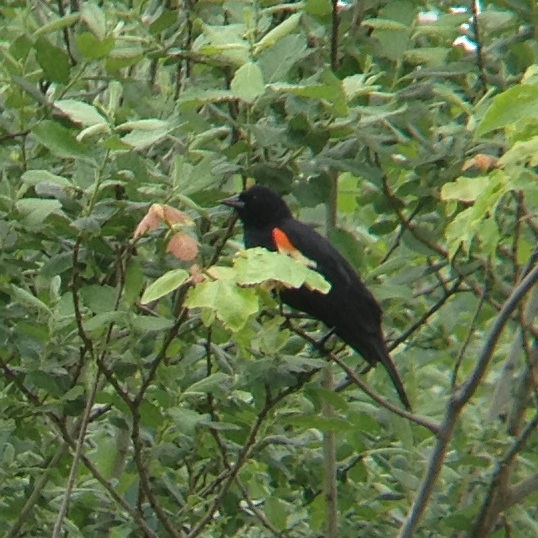
Red-winged Blackbird
But I pushed these thoughts from my mind and concentrated on the omnipresent blackbirds and their raucous calls. A few Canada geese floated out on the pond, and a single mallard flew over and pretended to preen; I think she really just was looking to see if I might offer her something to eat. A great blue heron flew across the pond, while a second stalked the shallows on the far shore. My last find of the day was a red-tailed hawk lazily soaring over Hammond Pond.

According to eBird data, Hammond pond and the surrounding woods (including Webster Conservation Area and Houghton Gardens) is one of the best birding locations in Newton, second only to Nahanton Park. I just hope that we can keep it that way.


Hammond Pond


Monday, March 5, 2012

The Beginings of Spring

I stopped by Hammond Pond for a few minutes this weekend. Mostly it was the regulars, hooded and common mergansers, mallards and a single black duck, and ring-billed gulls. The great black-backed gull who had stayed for a few weeks was gone, nor could I find the ring-necked ducks.

But my walk to work this morning was much more eventful. As soon as I stepped outside the house I was greeted by the two noted "phoebe" mating call of the black-caped chickadee, usually one of my first signs of spring and the impending chorus of birdsong. I do miss the slightly more musical four-noted song of the more southerly Carolina chickadee: "fee-bee fee-bay". The song sparrow who has been gracing the us with his complex song was absent from his usual tree. But before I turned down the next street I had an excellent consolation prize. The slurred liquid whistles of a single northern cardinal rang out and I looked up to find this brilliant red specimen singing with full morning light to show him off in stark contrast to the branches of the bare oak he was perching in. This cardinal certainly knows that spring is on the way.

Friday, February 17, 2012

Open Water at Hammond Pond

Red-Tailed Hawk
I was able to stop by Hammond Pond for a few minutes and was able to catch the pond open with just a little ice clinging to the edges. While I've been missing a good New England snow this winter, it certainly has made for some good birding at the local ponds. With 150 Canada geese to go through there were a number of mallards, common mergansers, and hooded mergansers. I was lucky that a couple of hooded mergansers and ring-necked ducks were quite close to the overlook close to City Sports and offered some great views before they became too shy. My best find of the day was a black-backed gull floating out in the middle of the pond. Normally the gulls here are all ring-billed and herring gulls, so this one was certainly a surprise. Right as I left, a red-tailed hawk came soaring in over the parking lot and spooking some starlings before settling on a branch overlooking Star Market.