Saturday, May 26, 2012

An Early Summer Afternon at Hammond Pond


A hungry mallard
At about 2pm today I stopped by Hammond Pond briefly to see if there might be any spotted sandpipers feeding on the lily pads.  From the over looks at the parking lots I could not spot any sandpipers, but I was quickly greeted by the songs of a Baltimore oriole and warbling vireo while an eastern kingbird splashed down into the water right in front of me before flying off.

Visiting Hammond Pond is a mixed experience for me these days. There is a lot of construction at the shopping center, but the trees blocked most the activity from view. However, on the pond itself, there is a floating "raft" holding up a pipe that looks like it is being used to pump water out of the construction site. I don't know about you, but I cannot imagine that this particular activity is any good for the health of the pond. The company that owns Chestnut Hill Shopping Center, WS Development,  is responsible for about 25% of the land abutting Hammond Pond. The proximity of the parking lots to the water edge increases run-off and pollution and would not be up to current development standards. I am worried that they are not as concerned about the health of the pond or the residents who enjoy it as they should be. They must appreciate the pond's beauty, however, as they are also about to replace the building that currently holds City Sports with a taller building with the top floor (with an excellent view of the pond) serving as their corporate headquarters.

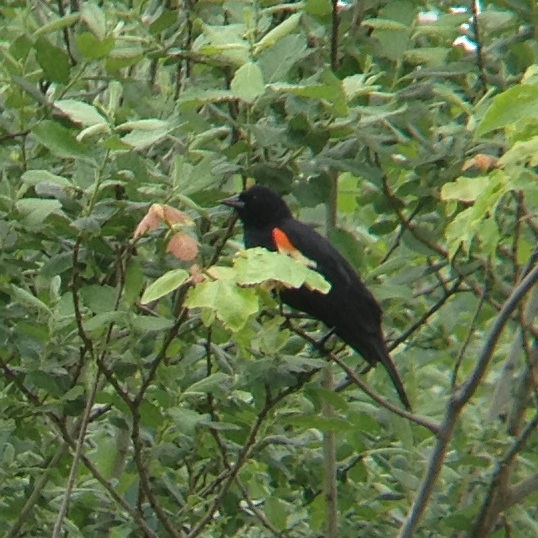
Red-winged Blackbird
But I pushed these thoughts from my mind and concentrated on the omnipresent blackbirds and their raucous calls. A few Canada geese floated out on the pond, and a single mallard flew over and pretended to preen; I think she really just was looking to see if I might offer her something to eat. A great blue heron flew across the pond, while a second stalked the shallows on the far shore. My last find of the day was a red-tailed hawk lazily soaring over Hammond Pond.

According to eBird data, Hammond pond and the surrounding woods (including Webster Conservation Area and Houghton Gardens) is one of the best birding locations in Newton, second only to Nahanton Park. I just hope that we can keep it that way.


Hammond Pond


Tuesday, May 22, 2012

A Birdy Spring Afternoon at Newton Cemetery

Newton Cemetery
Earlier this month there was a mass bird post from some Newton birders noting the warblers they found at Newton Cemetery. That reminded me that Suzette and Scott would posts from the Cemetery, noting rarities like a Eurasian Widgeon. Between that and wanting to stay out of really woodsy areas for tick purposes, Newton Cemetery seemed like a great destination on Sunday. Similar to its more famous cousin, Mt. Auburn Cemetery, Newton Cemetery is a garden cemetery and its beauty struck me as soon as I entered the grounds just after 5pm. The azaleas and rhododendrons were in full bloom and the massive oaks lining the shores of the ponds added to the serenity.

Red-tailed Hawk in a Rhododendron
Blue jays and warbling vireos assaulted my ears as I walked the roads and paths following the ponds and streams across the grounds. Baltimore orioles added their wonderful songs to the air. I ran across a large group of agitated grackles who alerted me to the presence of a red-tailed hawk they were mobbing. The hawk seemed almost oblivious to me, being more concerned with keeping her head down or wanting me to flush a rabbit, squirrel, or muskrat on my walk. (Cornell Lab of Ornithology has an awesome streaming camera on a red-tailed hawk nest full of young hawks).

Warbling Vireo
At the next pond a dry rattle announced the presence of a belted kingfisher who shyly headed off before I could see more than some blue wings. Though a pair of eastern kingbirds didn't seem to mind as they called constantly making a few splash-downs on the surface of the pond. Were they hunting or drinking? If the later it was so much less elegant than a swallow's graceful in-flight drink. The path along the little steam yielded a warbling vireo, while he didn't want to sit still he seemed to enjoy the attention I was giving him from just a few yards away as he flitted between branches and occasionally dove at the stream making and auditory splash before returning to the brush. Was he drinking? After about 20 blurry pictures I finally got a good pose. This close encounter with the warbling vireo was certainly the highlight of the walk.

A Juvenile Robin
The only warblers were some Yellows, but the abundance of brightly colored orioles made up for the low warbler count. On my way back, I again passed the mob of grackles and the red-tail, I was starting to feel sorry for her, but the harassing must have been worth it or she would have moved further away. Just then I saw a flash of dark blue across the lake and was able to finally have a distant but good view of the belted kingfisher with her double breast bands of navy and burnt orange. A great way to end my walk at the Newton Cemetery.

Sunday, May 13, 2012

May Migrants at the Emerald Necklace: Riverway

A Goldfinch Pair
Boston's Emerald Necklace is just a short T ride down the D-line. While most Boston area birders prefer the Back Bay Fens or Arnold Arboretum, the Riverway is right off the D-line and quite convenient to Newton birders. This narrow strip of park is centered upon the Muddy River and connects the Fens to Olmsted Park and Jamaica Pond, and fortunately offers enough habitat to offer shelter to tired migrants. I recently decided to stop off for some birding at Riverway on my way into Boston.

After getting off the T, the Riverway is accessed directly from the Longwood stop by heading over what I can only assume is a dike to ensure that the Muddy River and the T tracks never meet. As Riverway has paved or gravel trails on both sides of the River I decided to make a loop with Park Dr. on one side and Brookline Ave. on the other.

Black-and-white Warbler
Right away my ears were asaulted by the songs of Nothern Parulas, Black-throated green and Black-and-white warblers. The songs even led my eyes to these warblers for some great views (the Parula was quite high in the oaks).  Ovenbirds called from the under growth, but never showed. While walking the banks of the Muddy River I noted that there were a couple of families in the river, both Mallard and Canada Geese. The goslings were starting to get lanky and less cute, but the mallard chicks looked more like corks bobbing in the water than the smooth paddling of their mom.

Northern Waterthrush
Further down the trail, the river widens forming large pools with small islands. These islands were quite popular with warblers where I heared a Black-throated Blue's buzzy "zoo zoo zoo zree" song! An American Redstart showed up flashing his brilliant red-orange patches on this black body and calling "tse tse tse tse-o." Along the shores of the river I found a small thrush-like bird bobbing his tail, a Northern Waterthrush, a warbler that looks and acts like thrushes by foraging on the banks of streams and ponds and sharing a spotted breast with thrushes. And speaking of thrushes, was even lucky enough to catch the song of a Swainson's thrush. A beautiful flute-like raising song that he sang softly until a dog got a little too close for comfort and he became nervous. The spotted thrushes (including Veery, Wood, Hermit, Swainson's thrushes) are among North America's best songsters and as I have only heard the Wood Thrush's ethereal song before, I was disappointed not to be able to snatch a recording of the Swainson's Thrush song. I was able to spot him well enough to make out the buff colored spectacles and face that is the hallmark of the Swainson's thrush.

Just before leaving I managed to find a Common Yellowthroat, a Spotted Sandpiper, and a female Red-wing Blackbird on her nest (she flew off just before I could take a picture).


The Longwood Ave. bridge over the Riverway was originally designed by Frederick Olmsted, the master planner for the Emerald Necklace.

Thursday, May 3, 2012

Accidental Birding

I very much enjoy accidental birding (finding a fund bird when you aren't birding). Finding a fun bird when you aren't looking for it makes the find that much sweeter. Seeing Wild Turkeys or Wood Ducks from the T or the Red-tailed Hawk from your window at work are always quite a treat.

Yellow-rumped Warbler
Just this weekend, I was in the yard and heard a soft musical warble similar to a Pine Warbler, except that the warble sometimes changed pitch half way through. I knew it had to be a warbler as I had just heard this song on my bird song CDs.  So I hunted for the singer to find a beautiful Yellow-rumped Warbler. I was even lucky enough to grab a couple of pictures. Keeping the binoculars on the back steps while in the yard certainly paid off. With spring migration in full swing now, you never know when there will be a great bird in the backyard or just outside work. And I think a warbler in the backyard is particularly good, even for accidental birding.

For the start of warbler season I wanted to share links for YouTube videos from the Cornell Lab of Ornithology on tips for finding warblers and a warbler ID quiz. They are worth watching just to see great video of these birds and to hear their calls.


Saturday, April 28, 2012

Loss of a Great Horned Owl at Forest Grove Reservation

Muscovy Duck (Domestic)
Today I joined the bird walk along the Charles sponsored by the Newton Conservators and the Waltham Land Trust. The walk focused on the Auburndale Park area along the Charles. I was about 30 minutes late when I parked by the old watch factory in Waltham and was walking quickly when I was surprised to find a pure white water fowl. Upon closer inspection it proved to be a Muscovy Duck! The wild Muscovy is native to Central and South America, but this all white duck is a domesticated type. (There is an article here about domestic and hybrid ducks). The only other time I have ever seen a Muscovy was a pretty black and white duck domestic loose in the middle of the Australian bush, go figure. This is also only the 3rd ebird record in MA. I snapped a quick picture and carried on. When I finally caught up to the group they were enjoying great views of a number of Wood Ducks, Mallards, and a pair of Mute Swans with goslings. Just then a large accipiter flew across the river. Because it was so large is was likely a Cooper's though I didn't see it well enough to be sure.

Mute Swan and goslings
We continued into Forest Grove Reservation and the Flowed Meadow wetlands. We heard a few Cowbirds and lots of Red-Winged Blackbirds. Further into the Flowed Meadow I thought I heard the high, thin, wheezy notes of a Blue-gray Gnatcatcher. I fell behind most of the group to see if my eyes could confirm what my ears had already told me. It took a little bit of work but we finally found it and could see its small build and the white feathers on the edges of his long tail. This little wonder of the forests looks like a small Mockingbird, is shy and quick like a warbler, but has little musical skill. Further along, three Downy Woodpeckers were calling and tussling. Were the two males arguing over territory or a mate? When we finally entered Auburndale Park proper, we found a Yellow-rumped Warbler, a Chipping Sparrow, and a second Gnatcatcher.

On our way back towards the cars, Alison, one of our group leaders, found a dead Great Horned Owl! At first I was quite confused thinking she had found an owl pellet and didn't figure it out until I could see the owl. While in actuality he was a quite large owl, his stiff body and rumpled feathers seemed diminished compared to the Great Horned Owls of Houghton Gardens. While the spark that gave this owl life was gone, up close you could truly appreciate his massive talons and heavy beak. The rumpled feathers revealed his downy under coat to be a rich auburn and the feathers of his ear tufts seemed so wispy and fragile. We all wanted to think that he was an old man of forest and had peacefully died in his sleep and slipped off his White Pine. We quickly tried to alert those who might be interested in a dead owl, but on a Saturday it took a couple of hours to find a home for him at Harvard's Museum of Comparative Zoology who arranged to collect the owl. While it was sad to to think that this powerful predator will no longer grace our forests with his silent flight and haunting calls, I hope that he may yet be able to contribute to science and conservation.

Wednesday, April 25, 2012

Mark Your Calendars

Spring walks and volunteer opportunities around Newton are under way so mark your calenders and check out the Newton Conservator's website for more details. And while you are there be sure to check out and read the great article about the history of Turkeys in Massachusetts.

April 28, Saturday. Bird Walk in Waltham
April 29, Sunday. NewtonSERVES Projects all around Newton
                            (Nahanton, Saw Mill Brook, Blue Heron Bridge, Dolan Pond)
May 2, Wednesday. Newton Conservators Annual Meeting.
May 6, Sunday. Garlic Mustard Pull at Cold Spring Park.
May 6, Sunday. Newton Aqueducts Hike.
May 12, Saturday. Garlic Mustard Pull (Locations TBD).
May 13, Sunday. Nahanton Park Mother's Day Bird Walk.
May 19, Saturday. Bird Walk at Cold Spring Park (Rain date May 20).
May 20, Sunday. Canoe/Kayak Trip at Nahanton Park.
June 3, Saturday. Fern Walk in West Webster Woods (Rain date June 4).


Monday, April 23, 2012

Breaking News: Long-tailed Ducks at Chestnut Hill Reservoir!

Long-tailed Ducks with Ruddy Ducks
Yesterday Ryan Schain posted on Massbird that he found two Long-tailed Ducks at Chestnut Hill Reservoir. These diving sea ducks tend to stick to the ocean or the Great Lakes. In the arctic they breed in ponds, streams, and marshes, but they mostly winter off shore on the open ocean. So on my way home from work yesterday I stopped by the reservoir and I was able to pick them out from the Ruddy Ducks from across the reservoir with their stockier body and color pattern with white along the waterline and dark back and head. I thought I could even make out the long tail at the distance (on the male, center of the picture). After a lot of walking in the rain was finally able to get much better views (and bad pictures) where I could discern the lighter face patch on the dark head and the long thin tail held up at an angle was quite visible. These ducks are quite unique with three distinct plumages giving them an ever changing appearance through out the year as they frequently molt. The Long-tailed Ducks are also the deepest diving ducks reaching depths of 200 ft. But while I was watching they weren't diving and they seemed mostly preoccupied with getting in a good nap. So if you get the chance get out there and check them out!

As a side note the original post from Ryan also mentioned Baltimore Orioles and Eastern Kingbirds, so keep your eyes out. Also of note, I also found a Palm warbler and a few Yellow-rumps and a Flicker who didn't seem to mind the pouring rain at all.

4/26 Update. I just saw that Ryan has great pictures of the pair on his Flickr stream you can check out here.